New data for fast validation of our model exceeds expectations
What We Did:
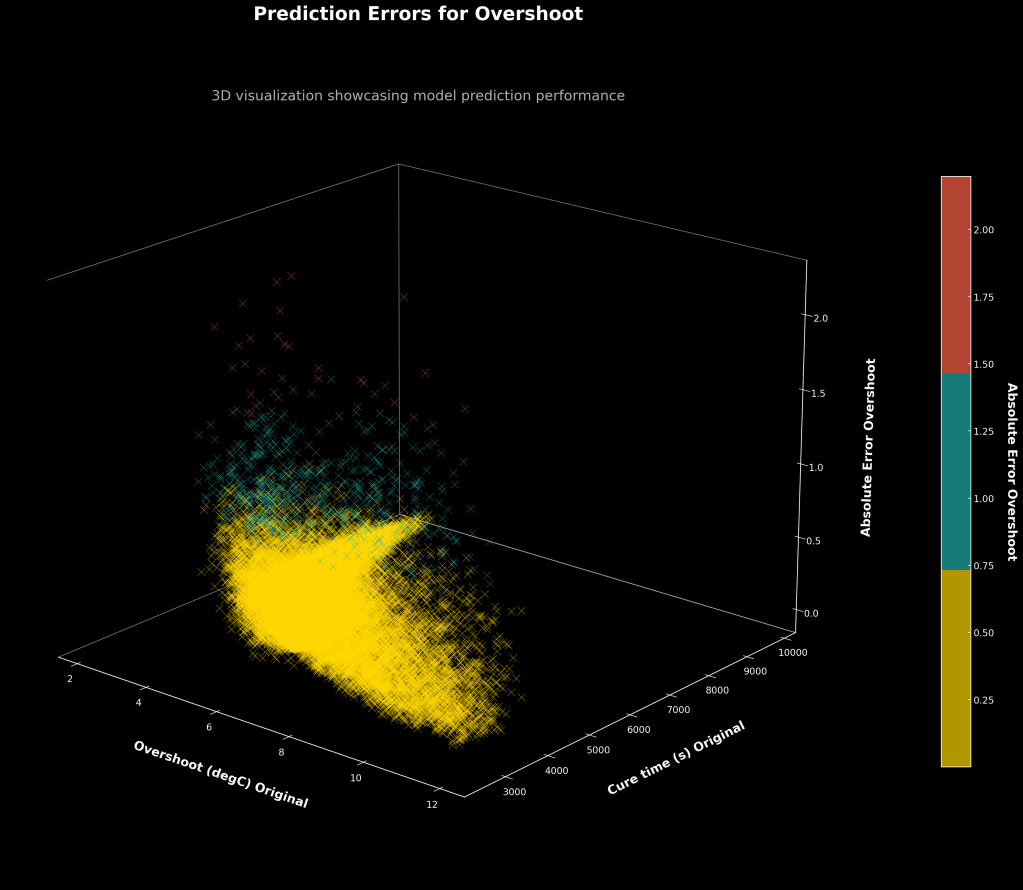
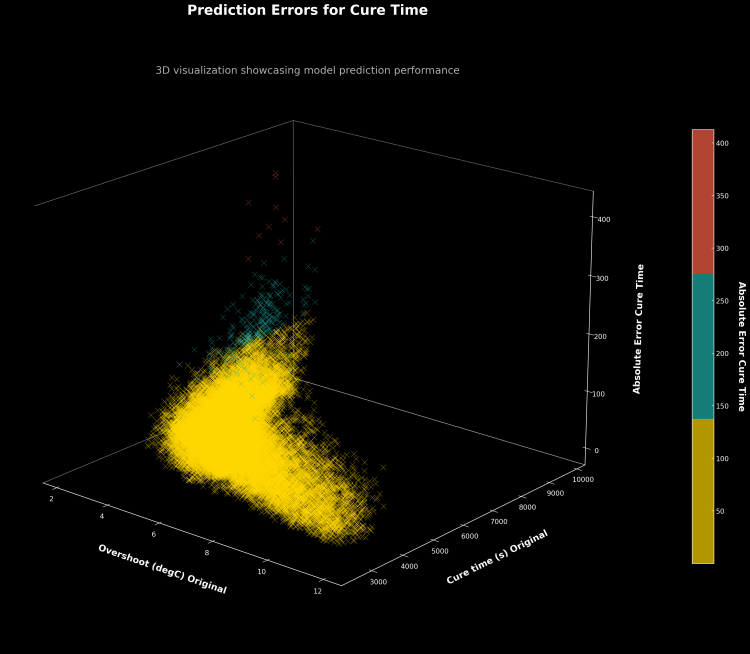
We analyzed a set of thermocouple readings from two distinct areas of our RTM-6 material embedded with carbon fiber. This deep dive allowed us to understand the heating and cooling cycles intimately.Using our ML/Ai framework we demonstrated very accurate predictions in near real-time.
💡 Key Insights:
- The upper and lower parts of the material exhibit different thermal behaviors. This understanding can help in optimizing the curing process tailored to each section.
- By leveraging a predictive model, we gauged the cure time and overshoot temperature resulting in a strong validation with real-world data, reinforcing the model’s reliability.
🚀 Why This Matters :
- Efficiency: Accurate predictions can reduce waste, save time, and ensure the product’s structural integrity.
- Cost-Effective: Minimizing errors and refining the curing process can lead to significant cost savings.
- Quality Assurance: Consistent and accurate curing means a high-quality end product, every single time.
🔍 Validation with Real Data:
Our partners and collaborators greatly enchanced our validation process with real data , showcasing the model’s robustness and reliability. We now plan for an even bigger run with a more diverse dataset. We need to highlight that these results are in almost sub-second time .
Debunking Myths: The Technical Realities of Data-Agnostic Machine Learning Solutions

There is a lot of interesting solutions when it comes to data agnostic systems especially in the ML/AI space. In this post we are taking a quick look at data-agnostic machine learning, addressing prevalent myths, and presenting the realities. As we have been building our mvp we are in the position to show how our product aligns with these truths .
🔮 Myth #1: “Data-agnostic” means it can work with any data
Truth: “Data-agnostic” signifies a system’s ability to process diverse types of data, not necessarily all forms of data. It’s about flexibility and adaptability in handling various data formats, thanks to a robust preprocessing pipeline.
🎭 Myth #2: Data-agnostic solutions are Jacks-of-all-trades, masters of none
Truth: A well-designed data-agnostic system leverages the power of modularity, where each module specializes in a specific function. This approach allows the system to be both versatile and proficient.
🔒 Myth #3: Data-agnostic systems are less secure
Truth: Security in a data-agnostic system is as robust as any other system. Employing secure data pipeline management and privacy-preserving techniques ensures the data remains secure during transit and processing.
📐 Myth #4: Data-agnostic solutions are less precise
Truth: With advanced machine learning algorithms, rigorous cross-validation strategies, and precise hyperparameter tuning, a data-agnostic system can deliver accurate and reliable insights across diverse data types.
⚙️ Myth #5: Data-agnostic tools are complex to use
Truth: Despite their sophisticated architecture, data-agnostic systems can be designed with user-friendly interfaces and comprehensive support to ensure accessibility and ease of navigation.
Now, let’s talk about what Talos is doing with our product. The design principle is a modular architecture that is bringing together robust preprocessing capabilities, a modular design, top-tier security protocols, precise machine learning techniques, and an intuitive user interface.
Our solution provides:
Flexibility: It can handle both structured and unstructured data, making it ideal for diverse data analysis tasks.
Specialization: Each module in our system is tailored for specific tasks (for example our exploratory data analysis is a key module), ensuring optimal performance across all functions.
Security: We prioritize data security, employing state-of-the-art encryption and privacy techniques.
Precision: We employ a rigorous cross validation scheme that is built into a model serving module leveraging ml/ai backed accurate and reliable insights.
Ease of Use: We are working hard on our interface in order to be user-friendly and coupled with comprehensive documentation and support.
As we continue our journey, we’re excited to share more insights and breakthroughs with you. Stay tuned!
#MachineLearning #DataAgnostic #AI #DataScience #Innovation
#MachineLearning #DataAgnostic #AI #DataScience #Innovation
ML predictor performance on our MPV
As we move further along in the development of our MVP for an ML-based system in composite manufacturing we see results that verify the robustness of our models. Part of our expertise is building ML enabled systems that are data agnostic and facilitate niche applications from different industries. In this particular use case, we are predicting the overshoot value and total curing time during the resin curing process in a composite manufacturing model set to be deployed in industrial environment.

Predicted vs True values of Overshoot (degC)
In composite manufacturing, the resin curing process is used to make strong composite materials. However, predicting how long the curing process will take and how much the temperature will overshoot can be difficult. Knowing the total curing time and overshoot value beforehand helps manufacturers to optimize the curing process, reduce waste, and improve the quality of the final product. This can lead to significant cost savings and a more efficient manufacturing process. Our AI solution is aimed at deployment in an industrial environment to improve the efficiency and accuracy of the manufacturing process.
Ai and the Evolution of the small tech business paradigm

Only a decade ago it would have been difficult to see the way small and midsize business (SMBs) could keep pace or even compete with larger companies when it comes to data technology and innovation. The paradigm of the small, agile business that can leverage AI and analytics has only become dominant in the last few years enabling all SMBs,from disruptive start -ups to innovation hubs, become very competitive in their respective industries.
The recent surge of AI advances, that have also stolen a lot of the limelight in the last year, has driven the point home even further. Applications like ai-driven chat bots and even coding facilitators, can accelerate the generated value and provide to an SMB a broader spectrum of services and products.
However, this expansion of capabilities and the use of AI and analytics, does come with its own set of challenges, which include:
Cost of implementation. SMBs may not have the resources to develop their own AI solutions. Nevertheless, as the technology continues to evolve, a growing number of cloud-based AI solutions has become available, which can be implemented without significant upfront investment.
Cultural shift in the way SMBs approach this technology. Many SMBs are hesitant to adopt these new technologies, viewing them as costly or disruptive or “suitable for much larger companies”, running the risk of being left behind. Realisation that AI and analytics have a firm place in ANY size company and a careful and step-wise approach in adopting these technologies can be employed to mitigate this challenge.
Both of these define a high-level view of this paradigm shift, and the adaptation is like moving from checkers to chess.
The Advisory services provided by Talos Analytics help navigate these challenges and offer an accelerated way forward to this transition. The use of a state-of-the-art technology stack

along with the TCSA Advisory Suite results in a flexible end-to-end solution that is Scalable, Adaptive, Iterative and offers guidance and communication with the customer at every step with continuous feedback.
In the coming weeks we will break down how this process works and the milestones SMBs can look forward to.
SPIE Photonics West commences on the 28th January with AI being at the forefront.

As the tech industry continues to evolve and innovate, one area that has been making significant strides in recent years is artificial intelligence (AI) and its applications in the field of photonics. This year’s SPIE Photonics West conference, set to take place on January 28th to February 2nd, is poised to be a particularly exciting event for those interested in this intersection of technology.
At Talos Analytics, we are thrilled to be participating in SPIE Photonics West and to have the opportunity to discuss our latest solutions in aerospace composite manufacturing and our overall AI framework. We believe that our work in this area aligns closely with the cutting-edge innovations that will be on display at the conference.
One of the key themes of this year’s conference is the use of AI and machine learning (ML) paradigms in biomedical optics, biophotonics, industrial lasers, optoelectronics, microfabrication, MOEMS-MEMS, displays, and quantum technologies, including quantum 2.0. These advancements have the potential to revolutionize a wide range of industries and we are excited to see how they will be applied in the coming years.
As attendees of SPIE Photonics West, we look forward to engaging in productive conversations and collaborations with other industry leaders and experts. We believe that this event will be a valuable opportunity to learn more about the latest advancements in AI and photonics and to explore potential partnerships and collaborations.
This year’s SPIE Photonics West will be a greatly influential event for the field of AI and photonics and we are excited to be a part of it. We do hope to see you there!
Generating Immense value for small and medium scale business through the use of AI is the way forward.
 Talos Analytics